Traditional Marketing vs. Digital Marketing: Where Your Budget Actually Performs

Published:
February 2, 2024
Updated:
March 18, 2026
The Debate That Refuses to Die — And Why Both Sides Are Wrong
Every year, some marketing blog publishes a breathless article declaring traditional marketing dead. And every year, businesses continue spending hundreds of billions on television, radio, print, and outdoor advertising. Both the obituary writers and the traditional holdouts are missing the point entirely.
Traditional marketing isn't dead. Digital marketing isn't universally superior. The real question — the one that actually affects your business outcomes — is far more specific: which channels produce measurable, attributable return on investment for your particular business, your particular audience, and your particular growth stage? That's not a philosophical debate. It's an analytics problem.
At Aragil, we've managed over $50 million in advertising spend across both traditional and digital channels for businesses ranging from local restaurants to global SaaS companies. The patterns we've observed don't fit the neat narrative that either camp wants to tell. Some traditional channels dramatically outperform digital for specific use cases. Some digital channels are wildly overrated for certain business models. And the most effective marketing strategies we've built almost always involve elements of both — deployed based on data, not ideology.
This article breaks down the actual, measurable differences between traditional and digital marketing across the dimensions that matter: cost structure, targeting precision, measurement capability, speed to results, and long-term asset value. No infographics. No oversimplifications. Just the practitioner's reality.
Defining the Terms: What "Traditional" and "Digital" Actually Mean in Practice
Before comparing anything, let's establish clear definitions, because the terms themselves have become imprecise to the point of uselessness.
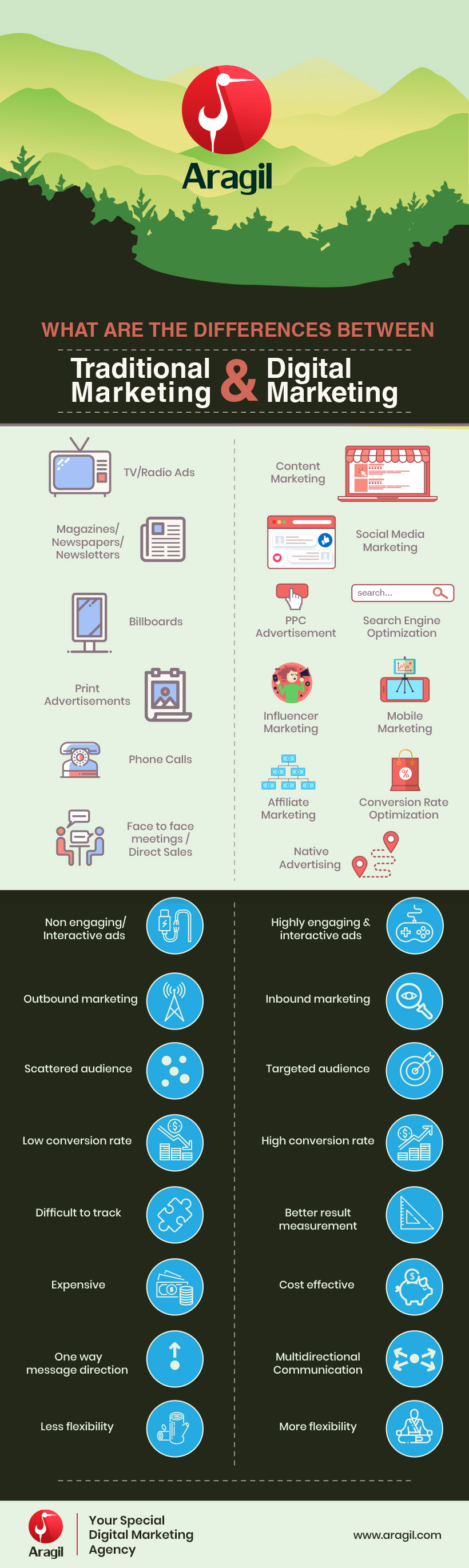
Traditional marketing encompasses any promotional channel that existed before the internet became a primary consumer medium. This includes television advertising (broadcast and cable), radio advertising, print advertising (newspapers, magazines, trade publications), direct mail, outdoor advertising (billboards, transit ads, signage), event marketing and trade shows, and telemarketing. The defining characteristic of traditional channels is their broadcast nature: the message goes out to a broad audience defined by the medium's reach, with limited ability to target specific individuals or measure individual-level response.
Digital marketing encompasses any promotional activity conducted through internet-connected channels. This includes search engine marketing (paid search and SEO), social media marketing (organic and paid), email marketing, content marketing, display and programmatic advertising, video marketing (YouTube, CTV/OTT), affiliate marketing, and influencer marketing. The defining characteristic of digital channels is their addressable nature: the message can be targeted to specific individuals based on their behavior, demographics, interests, and intent signals, with granular measurement of individual-level response.
These definitions matter because the comparison isn't really "traditional vs. digital" — it's "broadcast vs. addressable" marketing. And that framing changes the entire analysis.
Cost Structure: Why "Cheaper" Is the Wrong Metric
The most common argument for digital marketing is cost: it's cheaper to run a Facebook ad than a television commercial. This is technically true and practically meaningless. The relevant metric isn't cost per campaign or even cost per impression — it's cost per acquired customer, and on that metric, the picture is far more nuanced than the digital evangelists suggest.
Traditional marketing has high fixed costs and low variable costs. Producing a television commercial might cost $50K–$500K, and airtime on a major network runs into six figures. But the cost per impression is often remarkably low. A Super Bowl ad reaching 100+ million viewers delivers a CPM (cost per thousand impressions) that digital channels can rarely match at comparable scale. The problem isn't the cost — it's the waste. A significant percentage of those impressions reach people who will never be your customer, and you can't separate the valuable impressions from the wasted ones.
Digital marketing has low fixed costs and variable unit economics. You can launch a Google Ads campaign for $500 and start generating clicks within hours. But the cost per click in competitive B2B categories now regularly exceeds $15–$50, and customer acquisition costs through paid digital channels have increased 60–70% across most industries over the past five years. The "cheap" digital marketing of 2015 no longer exists. Platform consolidation, increased advertiser competition, and privacy-driven targeting degradation have pushed digital CPAs steadily upward.
The honest cost comparison isn't that digital is cheaper — it's that digital offers a lower barrier to entry and more granular budget control. A small business with $2,000/month can run effective digital performance campaigns. That same $2,000 buys essentially nothing in traditional broadcast media. But at scale, the cost advantage of digital narrows significantly, and for certain brand-building objectives, traditional channels deliver cost-per-awareness-point metrics that digital struggles to match.
Targeting Precision: The Real Digital Advantage (With Caveats)
If there is one genuinely structural advantage that digital marketing holds over traditional, it's targeting precision. The ability to show specific messages to specific people based on their demonstrated behavior and expressed intent is a fundamental capability difference, not merely an incremental improvement.
Traditional targeting is demographic and geographic. You can buy airtime during programs that skew toward certain age groups, income brackets, or interest categories. You can place billboards in specific neighborhoods. You can mail catalogs to specific zip codes. But the targeting resolution is coarse — you're reaching broad cohorts and hoping your audience is overrepresented within them. A radio ad for a divorce attorney on a commuter station reaches plenty of happily married people who will never need the service.
Digital targeting is behavioral and intent-based. Google Ads lets you show your ad to someone at the exact moment they search for your specific product category. Facebook and Instagram let you target people who have visited your website, engaged with competitors' content, or match the behavioral profile of your existing customers. Programmatic display lets you retarget website visitors across the entire internet. This isn't just better targeting — it's a different category of targeting entirely. You're not guessing who might be interested; you're responding to demonstrated interest signals.
However, the digital targeting advantage has eroded meaningfully in recent years. Apple's App Tracking Transparency framework, the deprecation and modification of third-party cookies, and increasingly aggressive privacy regulations have degraded the precision of behavioral targeting across all major platforms. Facebook's targeting capabilities in 2026 are measurably less precise than they were in 2020. Google's audience targeting has become more reliant on machine learning black boxes and less on transparent signal matching. The gap between traditional and digital targeting remains significant, but it's smaller than the industry acknowledges.
At Aragil, we've adapted to this targeting shift by building strategies that rely less on platform-dependent behavioral data and more on first-party data, contextual targeting, and intent-driven SEO — channels where the targeting precision is inherent in the medium rather than dependent on tracking infrastructure that's being systematically dismantled.
Measurement: Digital's Decisive Edge (When Done Right)
Measurement capability is where digital marketing's advantage over traditional is most clear-cut and least debatable. The ability to track individual user journeys from ad impression to website visit to form submission to closed sale is a transformative capability that traditional channels simply cannot replicate.
Traditional marketing measurement is inferential. You can correlate sales lift with campaign timing. You can run brand awareness surveys before and after campaigns. You can use promo codes or dedicated phone numbers to approximate direct response. But you cannot definitively trace an individual customer's journey from seeing a billboard to walking into your store to making a purchase. Traditional measurement tells you approximately what happened at an aggregate level. It rarely tells you precisely why.
Digital marketing measurement is observational. With proper analytics infrastructure, you can see exactly which ad a customer clicked, which pages they visited, how long they spent on each page, whether they downloaded a resource, when they returned to the site, and which touchpoint preceded their conversion. This isn't approximate — it's a documented behavioral record. When a client asks "where did this lead come from?", digital analytics can usually answer with specificity that traditional channels cannot approach.
This measurement advantage has profound strategic implications. It means digital campaigns can be optimized in real-time based on actual performance data. Underperforming ads can be paused within hours. Budgets can be shifted toward high-performing channels within days. Creative variations can be tested and iterated on a weekly or even daily basis. Traditional campaigns, by contrast, operate on planning cycles measured in weeks or months, with performance data that arrives long after the spending has occurred.
But here's the caveat most digital agencies won't share: measurement capability only creates value if the measurement infrastructure is actually built and maintained properly. We've audited companies spending $50K+ per month on digital advertising with broken conversion tracking, misconfigured UTM parameters, and analytics properties that hadn't been audited in years. Their digital campaigns were theoretically measurable but practically unmeasured — which is functionally identical to running a traditional campaign with no measurement at all. The advantage is real but conditional on operational discipline that many organizations lack.
Speed to Results vs. Long-Term Asset Value
Another critical dimension of comparison that most analyses oversimplify: the time horizon over which each approach delivers value.
Digital paid channels deliver immediate results with no residual value. Launch a Google Ads campaign today, and you can have qualified traffic on your website by this afternoon. That's genuinely powerful for businesses that need leads now. But the moment you stop spending, the traffic stops. Paid digital is a faucet, not a well. Every dollar of value requires a corresponding dollar of spend. There's no compounding, no asset accumulation, no long-term leverage. This isn't a criticism — it's a characteristic that should inform how paid digital fits into your overall strategy.
Organic digital channels deliver slow results with compounding value. SEO and content marketing are the exception within digital marketing. A well-written, well-optimized article published today may take 3–6 months to rank but can then drive free organic traffic for years. That article becomes an asset on your balance sheet — it generates value without ongoing spend. We have clients whose blog articles written two or three years ago still drive 30–50% of their monthly leads. No paid channel, traditional or digital, produces this kind of compounding return.
Traditional brand-building creates intangible but durable value. Television, radio, and outdoor advertising, when executed consistently over time, build brand recognition and mental availability that creates a persistent advantage in purchase decisions. Consumers don't search for brands they've never heard of. A strong brand built through consistent traditional exposure means lower customer acquisition costs across all channels, including digital. This brand equity is real, valuable, and extremely difficult to build through digital channels alone — particularly at the speed and scale that traditional broadcast media enables.
The strategic implication: the best marketing strategies layer these time horizons intentionally. Paid digital for immediate revenue. Organic content and SEO for compounding medium-term growth. Traditional brand-building (where budget allows) for long-term mental availability and acquisition cost reduction. Each layer serves a different strategic purpose, and eliminating any one of them creates a gap that the others can't fill.
When Traditional Wins: Use Cases Where Digital Falls Short
Despite the industry's digital obsession, there are specific scenarios where traditional marketing channels demonstrably outperform digital alternatives.
Local market dominance for physical businesses. A restaurant, dental practice, or retail store serving a 10-mile radius often gets more value from local radio, community newspaper advertising, and strategic outdoor signage than from digital campaigns competing for expensive local search terms. When we work with local businesses at Aragil, we typically recommend a hybrid approach: digital for intent-capture (Google Ads, Google Business Profile optimization) combined with targeted traditional for awareness-building in the specific geographic area the business serves.
Reaching demographics with low digital engagement. Despite assumptions about universal internet adoption, certain valuable customer segments — particularly older affluent consumers and specific professional demographics — are more reliably reached through traditional channels. A wealth management firm targeting retirees will often find direct mail and print advertising in targeted publications more effective than Facebook ads, because their target audience's digital engagement patterns don't align with platform advertising models.
High-credibility industries where medium matters. In categories like financial services, healthcare, legal services, and luxury goods, the medium itself conveys credibility. A full-page ad in a respected industry publication or a television spot during premium programming carries an implicit quality signal that digital advertising — where anyone can buy an ad for $5 — does not. This isn't rational, but consumer psychology rarely is. The medium shapes the perception of the message.
Event-driven marketing with physical presence. Trade shows, community sponsorships, experiential marketing events, and in-store promotions create multi-sensory brand experiences that digital channels cannot replicate. The handshake, the product sample, the physical booth — these create memory and relationship in ways that pixels on a screen cannot match.
When Digital Wins: The Cases Where Traditional Can't Compete
Equally, there are scenarios where digital marketing's structural advantages make it the clearly superior choice.
Any business where purchase intent is expressed through search. When potential customers actively search for solutions — "best CRM for small business," "emergency plumber near me," "digital marketing agency Armenia" — capturing that intent through search engine marketing is the highest-ROI marketing activity available. No traditional channel can intercept a customer at the moment of expressed need with comparable precision.
Businesses requiring rapid testing and iteration. Startups, new product launches, and companies entering new markets need the ability to test messaging, targeting, and offers quickly and cheaply. Digital channels let you test five ad variations this week, kill the underperformers, and scale the winner next week. Traditional campaigns require months of planning and execution before you learn anything about performance.
eCommerce and direct-to-consumer brands. When the entire purchase journey happens online — from discovery to consideration to purchase — digital marketing provides end-to-end visibility and optimization capability that traditional channels cannot match. The eCommerce brands we work with rely on digital for its ability to attribute every dollar of spend to specific revenue outcomes, optimize in real-time based on ROAS data, and scale spend predictably against performance targets.
B2B sales cycles with identifiable decision-makers. When you're selling to specific roles at specific companies, digital targeting through LinkedIn, programmatic account-based advertising, and intent-data platforms lets you reach individual decision-makers with personalized messaging. No traditional channel offers comparable precision for B2B audience targeting.
The Integrated Approach: How Smart Brands Deploy Both
The brands generating the best marketing outcomes in 2026 aren't choosing between traditional and digital — they're building integrated strategies that leverage the specific strengths of each channel type for different objectives within a unified marketing architecture.
The framework we use at Aragil follows a simple hierarchy. First, capture existing demand through digital intent channels (search marketing, retargeting). Second, build a compounding organic presence through SEO and content marketing. Third, amplify reach and accelerate growth through paid social and programmatic digital. Fourth, where budget allows and the audience warrants it, build brand mental availability through targeted traditional channels that create the awareness that feeds digital demand capture.
This isn't a theoretical exercise — it's how marketing budgets should be allocated based on measurable contribution to business outcomes. The specific mix varies dramatically based on business model, audience, geography, and growth stage, which is why blanket pronouncements about traditional vs. digital are fundamentally unhelpful.
The question was never "traditional or digital?" It was always "which combination of channels produces the most measurable business value for this specific business at this specific stage?" That's an analytics question, not a philosophical one. And answering it requires the kind of cross-channel expertise and measurement discipline that separates strategic marketing from channel-specific tactics.
If you're unsure whether your current marketing mix is optimized for your business reality, start with an audit. At Aragil, we analyze where every dollar goes and what it produces — across traditional and digital — so budget decisions are driven by data, not dogma.
Frequently Asked Questions
Is traditional marketing still effective in 2026?
Traditional marketing remains effective for specific use cases: local market dominance for physical businesses, reaching demographics with low digital engagement (particularly older affluent consumers), high-credibility industries where the advertising medium itself conveys quality signals, and event-driven marketing requiring physical presence. The key distinction is that traditional marketing's effectiveness is highly contextual — it excels in specific scenarios rather than being universally applicable. The businesses that still benefit from traditional channels are those whose target audiences, geographic focus, or industry credibility requirements align with what traditional media delivers.
What are the main advantages of digital marketing over traditional marketing?
Digital marketing's structural advantages over traditional marketing center on four capabilities: targeting precision (reaching specific individuals based on behavior and intent rather than broad demographic cohorts), measurement granularity (tracking individual user journeys from ad impression to conversion), optimization speed (adjusting campaigns in real-time based on performance data rather than waiting weeks for aggregate results), and barrier to entry (launching effective campaigns with budgets as low as $2,000/month). These advantages are most pronounced for businesses where purchase intent is expressed through online search, where rapid testing and iteration are strategically important, and where the entire purchase journey occurs online.
How should a small business decide between traditional and digital marketing?
Small businesses should prioritize digital marketing for demand capture — specifically search engine marketing and local SEO — because these channels intercept customers at the moment of expressed purchase intent, offer granular budget control, and provide measurable attribution. However, local businesses serving a defined geographic area should consider supplementing digital with targeted traditional channels like local radio, community publications, and strategic outdoor signage for awareness building within their service radius. The decision framework is straightforward: digital for intent capture, traditional for local awareness, with budget allocation proportional to the measurable return each channel demonstrates.
What is the cost difference between traditional and digital marketing?
The cost comparison is more nuanced than the common narrative suggests. Digital marketing has a lower barrier to entry (effective campaigns starting at $2,000/month versus traditional broadcast media requiring significantly larger minimums), but digital customer acquisition costs have increased 60–70% across most industries over the past five years. Traditional marketing has high fixed costs (production and media placement) but can deliver remarkably low cost-per-impression at scale. The relevant metric isn't which is "cheaper" in absolute terms but which delivers a lower cost per acquired customer for your specific business model — a question that requires measurement and testing rather than assumptions.
Can you combine traditional and digital marketing effectively?
Integrated strategies that leverage both traditional and digital channels based on their specific strengths consistently outperform single-channel approaches. The most effective integration follows a hierarchy: capture existing demand through digital intent channels first, build compounding organic presence through SEO and content, amplify through paid digital channels, and then build brand awareness through targeted traditional channels that create the top-of-funnel awareness feeding digital demand capture. The specific mix varies by business model, audience, geography, and growth stage, which is why the traditional vs. digital debate is the wrong framing — the right question is which combination produces the most measurable business value for your specific situation.
How do you measure traditional marketing ROI compared to digital marketing ROI?
Traditional marketing measurement is fundamentally inferential — you correlate sales lift with campaign timing, run brand awareness surveys, and use mechanisms like promo codes or dedicated phone numbers to approximate direct response. Digital marketing measurement is observational — you track individual user journeys from ad click to page visit to conversion with documented behavioral records. This measurement gap is digital marketing's most decisive structural advantage. However, measurement capability only creates value when the infrastructure is properly built and maintained — companies with broken conversion tracking or misconfigured analytics derive no more actionable insight from digital campaigns than they would from traditional ones.