Content Marketing, SEO, and Social Media: Why Running Them Separately Is Wasting Your Budget
.jpg)
Published:
March 18, 2018
Updated:
March 18, 2026
The Three-Silo Problem That Costs Businesses Thousands Every Month
Walk into most marketing departments — or most agency relationships — and you'll find the same structural failure repeated everywhere: content marketing, SEO, and social media marketing operate as three independent functions with three separate strategies, three different teams, and three competing sets of KPIs. The content team writes blog posts nobody searches for. The SEO team optimizes pages with content nobody wants to read. The social media team posts graphics that link to pages that don't convert. Everyone is busy. Nothing compounds.
This isn't a coordination problem. It's a strategic architecture problem. And it's the single most expensive inefficiency in digital marketing today.
At Aragil, we've audited hundreds of marketing operations across B2B, eCommerce, and local businesses. The pattern is remarkably consistent: companies spending $5K–$50K per month across these three channels typically waste 30–45% of that spend on activities that produce zero compounding value because each channel operates in isolation. The content doesn't serve the SEO strategy. The SEO strategy doesn't inform the social calendar. The social engagement doesn't feed back into content development. It's three separate engines burning fuel independently instead of one integrated system generating momentum.
This article is a practitioner's framework for fixing that — not with vague advice about "alignment" but with the specific operational mechanics that make content, SEO, and social media function as a single, self-reinforcing growth system.
Why These Three Channels Are Structurally Inseparable
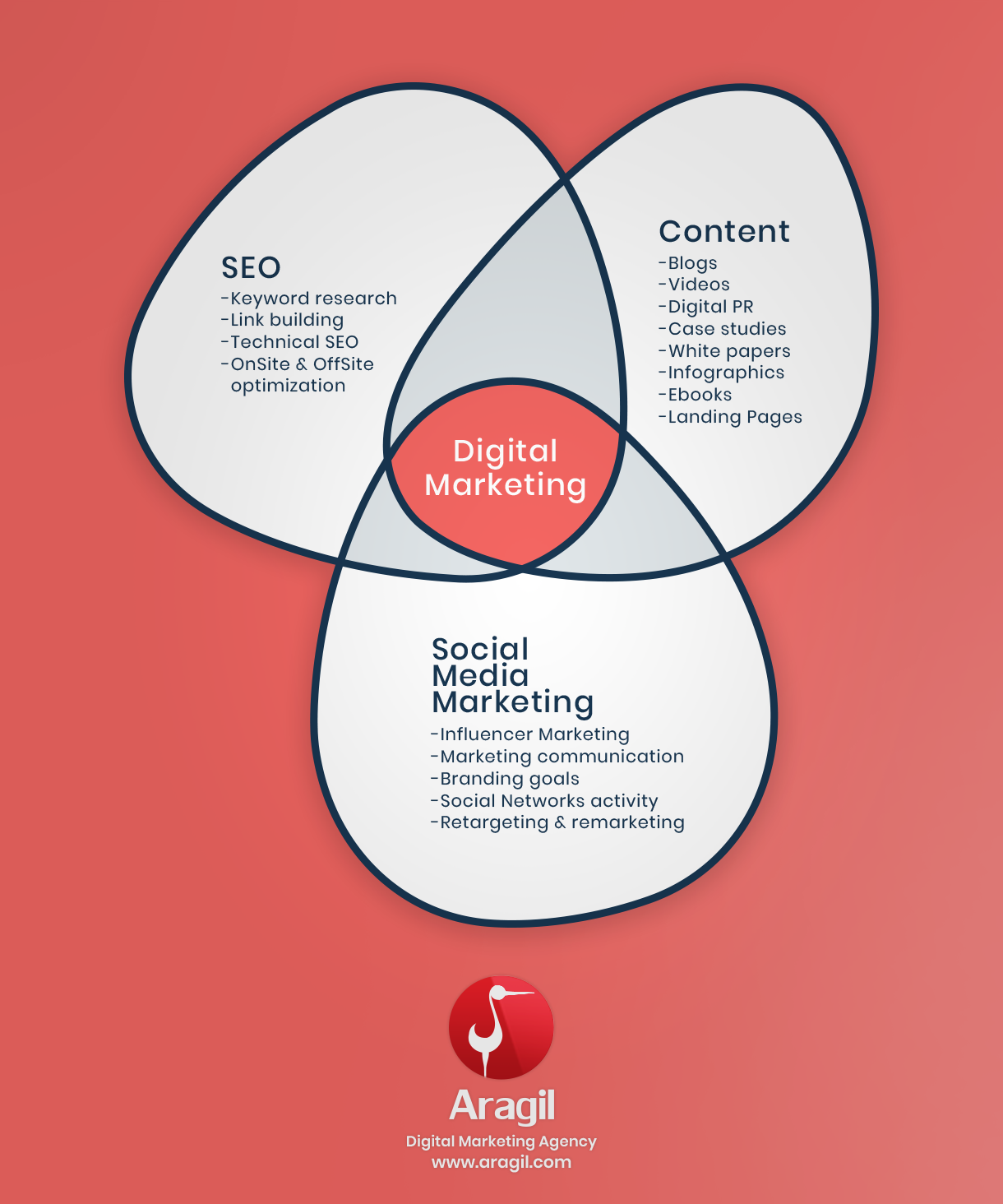
Before we get to the how, let's be precise about the why. Content marketing, SEO, and social media aren't just "related" — they are mechanically dependent on each other. Remove any one leg, and the other two collapse or dramatically underperform.
SEO without content is a house without walls. Search engine optimization is fundamentally a content discipline disguised as a technical one. Google doesn't rank websites — it ranks individual pages of content. Every keyword you want to capture requires a piece of content that earns the right to rank for it. Technical SEO (site speed, crawlability, schema markup) is necessary infrastructure, but without substantive content that matches search intent, technical optimization is like building a highway to an empty parking lot. You can have perfect Core Web Vitals and zero traffic if your content doesn't answer the questions people are actually asking.
Content without SEO is a library with no address. Plenty of companies produce genuinely excellent content — thoughtful articles, detailed guides, compelling case studies — that gets almost zero organic traffic because nobody thought about search intent during the planning phase. They wrote about topics their team found interesting rather than topics their audience is actively searching for. The result is a content library that looks impressive in a portfolio and generates nothing measurable in analytics. We see this constantly: companies with 50+ blog posts driving less than 500 organic visits per month because not a single article targets a keyword with commercial intent.
Social media without content is a megaphone with nothing to say. Social media teams often find themselves in a daily scramble for posts because the content pipeline either doesn't exist or wasn't designed with social distribution in mind. They resort to generic motivational quotes, behind-the-scenes photos, and trend-jacking that generates fleeting engagement but builds nothing durable. Meanwhile, the content marketing team is producing long-form articles that could be disaggregated into weeks of social content — but nobody set up that pipeline. Social becomes a standalone activity measured by likes rather than an amplification layer for content that drives actual business outcomes.
Content and SEO without social media lose their amplification engine. Organic search is a slow-burn channel. A new piece of content typically takes 3–6 months to reach its ranking potential. Social media provides the initial distribution surge that generates the early engagement signals, backlink opportunities, and brand searches that accelerate organic ranking. Companies that publish content and simply wait for Google to discover it are leaving months of potential impact on the table.
These aren't theoretical dependencies. They're observable in the analytics of every company that runs these channels. The question isn't whether integration matters — it's how to operationalize it.
The Integration Framework: One Strategy, Three Execution Layers
Effective integration doesn't mean one person does everything or that every piece of content serves every channel equally. It means all three channels operate from a single strategic foundation with coordinated execution. Here's the framework we use at Aragil when building integrated content strategies for clients.
Layer 1: Keyword-Driven Content Architecture. Everything starts with search intent research — not keyword volume, but intent classification. We categorize every target keyword into one of four intent buckets: informational (seeking knowledge), navigational (seeking a specific brand or page), commercial investigation (comparing options), and transactional (ready to buy). Each intent type requires a different content format, different depth, and different conversion mechanism. The content calendar is built from this keyword architecture, ensuring every piece of content has a specific organic search target and a defined role in the buyer journey. No article gets written because someone thought the topic was interesting. Every article gets written because the data shows the audience is searching for it with identifiable intent.
Layer 2: Content-First Social Distribution. Once the content architecture defines what gets created, the social media strategy becomes the distribution and amplification plan for that content. Each long-form piece is planned with social disaggregation in mind from the start. A single 2,000-word article typically yields eight to twelve social media assets: a key insight thread, a contrarian take, a data visualization, a quote graphic, a question prompt, a mini-case study excerpt, and a link-driving summary post. This isn't repurposing after the fact — it's designing content with multi-channel distribution as a core requirement.
Layer 3: Social Signals Feeding SEO Performance. Social media engagement doesn't directly affect Google rankings (this is one of the most persistent myths in digital marketing). However, social media indirectly accelerates SEO through several mechanisms: social distribution drives initial traffic that generates user engagement signals (time on page, pages per session) that Google does measure; social sharing exposes content to bloggers, journalists, and other content creators who may link to it organically; and social activity around branded terms increases branded search volume, which Google interprets as a positive authority signal. The integration isn't about social "boosting" SEO — it's about social creating the conditions in which SEO performance accelerates.
The Operational Mechanics: How This Works Week by Week
Frameworks are useless without operational specificity. Here's what integrated content-SEO-social execution actually looks like in practice, based on how we run these programs for our clients at Aragil.
Monthly planning cycle: The month begins with a keyword performance review. Which existing articles are gaining impressions but have low click-through rates? (These need title tag and meta description optimization.) Which target keywords have no content addressing them? (These become the new content briefs.) Which published articles have reached page-two ranking and need a content refresh to push to page one? This analysis produces the month's content priorities, which directly populate both the editorial calendar and the social media calendar.
Weekly content production: Content writers receive briefs that include the target keyword, intent classification, competitor content analysis (what currently ranks and what's missing from those pages), required word count based on competitive analysis, internal linking targets, and specific social media excerpt points to design into the content. The writer isn't just creating a blog post — they're creating a content asset designed for multi-channel deployment from the first sentence.
Publication and distribution sequence: When an article publishes, a coordinated sequence activates. Day one: full article shared on LinkedIn with a native summary (not just a link), key insight shared on Twitter/X as a standalone thought, and article submitted to relevant industry newsletters or communities. Days two through five: individual excerpts and data points shared as standalone social posts, each linking back to the full article. Days six and seven: engagement with comments, resharing of high-performing social excerpts, and monitoring of any organic backlinks the content has attracted. This isn't a one-and-done publication — it's a seven-day distribution campaign for every piece of content.
Monthly feedback loop: At month's end, social engagement data feeds back into the content strategy. Which social posts generated the most substantive discussion? Those topics deserve deeper content treatment. Which articles drove the most social traffic but low engagement on-site? Those need content quality improvements. Which organic keywords improved rankings during the month? Those deserve follow-up content targeting related long-tail variations. The loop closes, and the next month's plan is built on the previous month's data.
Common Integration Failures and How to Avoid Them
Even brands that recognize the need for integration frequently stumble on execution. Here are the most common failure modes we've observed.
Failure: "We'll create the content and then figure out SEO later." Retrofitting SEO into existing content is exponentially harder than building it in from the start. Once an article is structured, the heading hierarchy set, and the natural language patterns established, inserting keyword optimization without destroying readability is a delicate surgery that rarely succeeds fully. SEO considerations must inform content creation from the briefing stage, not the editing stage.
Failure: "Our social media manager will just pull from the blog." If the content wasn't designed for social disaggregation, the social media manager is forced to create derivative content on the fly — typically generic summaries or out-of-context quotes that don't perform well. The solution is including social excerpt specifications in the original content brief so the writer intentionally creates shareable, standalone statements within the article.
Failure: "We'll measure each channel separately." When content marketing is measured by page views, SEO by keyword rankings, and social media by engagement rate, the team optimizes for three different outcomes that may conflict. A social post that drives massive engagement but zero traffic to the website looks great in the social report and terrible in the content report. Integrated measurement means tracking the full journey: social post → website visit → content engagement → conversion event. This requires shared analytics access, agreed-upon attribution models, and unified reporting — unglamorous operational work that makes everything else possible.
Failure: "We hired three specialists and assumed they'd coordinate." Specialists optimize for their domain. An SEO specialist will push for keyword-dense content that reads like a search engine document. A content specialist will prioritize narrative quality over search optimization. A social specialist will favor viral potential over evergreen value. Without a strategist who owns the integration layer — someone whose job is specifically to ensure these three functions serve a unified goal — specialization becomes fragmentation. At Aragil, this integration role is central to every performance marketing engagement we run.
The Compounding Effect: Why Integrated Strategies Win Over Time
The most powerful argument for integration isn't efficiency — it's compounding. Isolated channels produce linear results: publish a post, get some traffic, traffic decays, publish another post. Integrated channels produce exponential results because each activity amplifies every other activity.
A well-optimized article ranks on Google, driving consistent organic traffic. That traffic generates engagement signals that improve ranking further. Social distribution of the article generates backlinks and brand searches that further boost the article's authority. The article's SEO performance drives email subscriber growth, which creates a distribution channel for future content, which generates more social engagement, which creates more backlinks. Each cycle through the loop adds energy to the system.
We've seen this compounding effect deliver dramatic results. Clients who transition from siloed to integrated execution typically see a 40–70% increase in organic traffic within six months — not from producing more content, but from making their existing content work harder across all three channels simultaneously. The total output increases while the total input (budget, team hours) remains constant. That's the operational definition of marketing efficiency.
The businesses that will dominate organic digital growth in the next decade won't be the ones that spend the most on content, SEO, or social media individually. They'll be the ones that figured out how to make all three function as one system. If your current setup still treats these as three separate line items with three separate strategies, the integration gap is where your competition is gaining ground.
Ready to audit your current setup? Get in touch with Aragil — we'll map where the integration gaps are costing you and build the unified strategy that makes your existing investment compound.
Frequently Asked Questions
Can content marketing work without SEO?
Content marketing can exist without SEO, but it dramatically underperforms. Without search intent research guiding topic selection, content teams typically produce articles that their organization finds interesting rather than what their target audience is actively searching for. The result is a content library that may look impressive but generates minimal organic traffic. We regularly audit companies with 50+ published articles driving fewer than 500 monthly organic visits because no article targets a keyword with commercial search intent. SEO doesn't just amplify content — it ensures the content addresses real demand.
Does social media directly affect SEO rankings?
Social media engagement does not directly influence Google's ranking algorithm — this is one of the most persistent myths in digital marketing. However, social media indirectly accelerates SEO performance through several documented mechanisms: social distribution drives initial traffic that generates on-site engagement signals Google does measure, social sharing exposes content to bloggers and journalists who may create organic backlinks, and social activity around branded terms increases branded search volume that Google interprets as an authority signal. The relationship is indirect but operationally significant.
How do you measure the ROI of an integrated content-SEO-social strategy?
Effective measurement requires tracking the full journey across channels rather than measuring each channel in isolation. This means monitoring social post engagement through to website visit, on-site content engagement, and ultimate conversion event using shared analytics access, agreed-upon attribution models, and unified reporting. Key metrics include organic traffic growth attributable to content, conversion rates by content type and traffic source, social-assisted conversions where social was part of the path but not the final touchpoint, and the compounding growth rate of organic performance over time.
What is the ideal content-to-social ratio for distribution?
A single well-structured long-form article (2,000+ words) should yield eight to twelve distinct social media assets when designed for multi-channel distribution from the start. These typically include a key insight thread, a contrarian take post, data visualizations, quote graphics, question prompts, mini-case study excerpts, and a link-driving summary post. The critical distinction is designing content with social disaggregation in mind during the briefing phase, not attempting to repurpose after publication. Retrofitted social content consistently underperforms content that was purpose-built for multi-channel deployment.
How long does it take for an integrated strategy to show results?
Organic search results from new content typically take 3–6 months to reach their ranking potential, but integrated strategies accelerate this timeline significantly because social distribution generates the early engagement signals, backlink opportunities, and brand searches that improve ranking velocity. Most clients we work with at Aragil see measurable improvements in organic traffic within 60–90 days of transitioning from siloed to integrated execution, with the compounding effect producing a 40–70% traffic increase within six months — without increasing content production volume, simply by making existing content work across all channels simultaneously.
What's the biggest mistake companies make when trying to integrate content, SEO, and social?
The most common failure is hiring three specialists and assuming they'll coordinate naturally. Specialists optimize for their domain: SEO specialists push for keyword-dense content, content specialists prioritize narrative quality, and social specialists favor viral potential over evergreen value. Without a dedicated integration strategist whose specific role is ensuring all three functions serve a unified commercial goal, specialization becomes fragmentation. The second most common failure is measuring each channel with separate KPIs that may conflict, creating incentives for channel-specific optimization at the expense of overall business outcomes.
%20(26).jpg)
%20(33).jpg)
%20(10).jpg)
